| The Harz Narrow Gauge Railways (Harzer Schmalspurbahnen) are the largest network of narrow gauge railways in Germany. They connect the principal cities of Wernigerode, Nordhausen and Quedlinburg and several smaller towns in the area with about 140 kilometers of 1000mm gauge track. The lines has numerous steep gradients and runs through areas of outstanding natural beauty as well as into the heart of one of Germany's major industrial cities. The oldest of the three lines in the Harz Mountains is the Selketalbahn which runs from Quedlinburg via Gernrode to the junction with the Harzquerbahn at Eisfelder Tamuhle. The original section from Gernrode - Stiege was opened throughout in 1891 although the connection to Eisfelder was not opened until 1905. This line has the least traffic on the network but features two branches: from Stiege to Hasselfelde, and from Alexisbad to Harzgerode. The main line from Gernrode arrives in Stiege such that trains are facing, effectively, the wrong direction and so a loop has been provided so that locomotive hauled trains can continue to Eisfelder Talmuhle without having to run the locomotive round the train. Steam workings over the Selketalbahn are very limited with only two or three trains a day although there is a more intensive service using diesel railcars. There is currently no timetabled steam workings between Stiege and Eisfelder Talmuhle. The section of the Harzquerbahn from Nordhausen to Ilfeld opened in 1897 with a further extension of the line to Drei Annan Hohne opening in 1899 where it met up with the Brockenbahn. The third line, the Brockenbahn, opened between Wernigerode and Schierke in 1898 with the line from Schierke to the summit of the Brocken opening in the following year. The Brockenbahn was conceived as a tourist railway to enable visitors to reach the summit of the Brocken Mountain and over 100 years later the Brockenbahn continues to be well-patronised with six or seven steam hauled trains per day. The railway runs a number of its trains with steam haulage, mostly employing 1950's vintage 2-10-2 tank locomotives, hauling traditional open-platform carriages. Further details can be found on the railway's own website which is only available in German. The pictures below were taken during a 1999 visit to the railway which was then celebrating its 100th anniversary. In addition to the regular service trains a number of special workings took place to reflect the history of the line but I have largely avoided using these to give a clearer view of the way in which the working railway operated then and fourteen years later there is little significant change. |
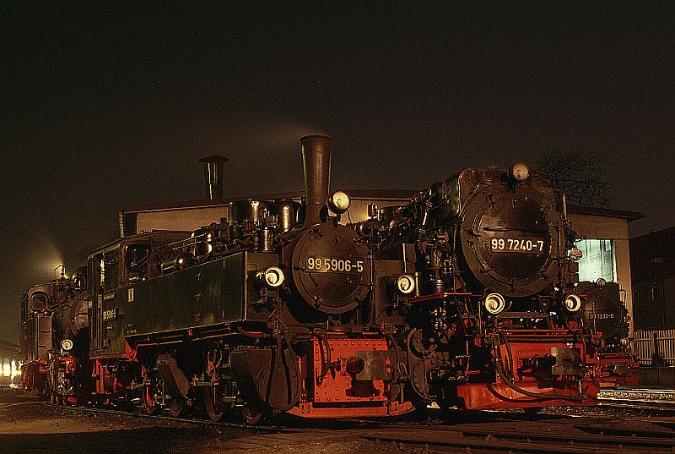
| During the festival in 1999 access to the yard at Wernigerode was possible and so night shots became a real possibility. Here Mallet 0-4-4-0 No.99-5906 and LKM 2-10-2 No.99-7240 stand under the shed lights in light steam A total of eighteen 2-10-2's are used on the Harz system |
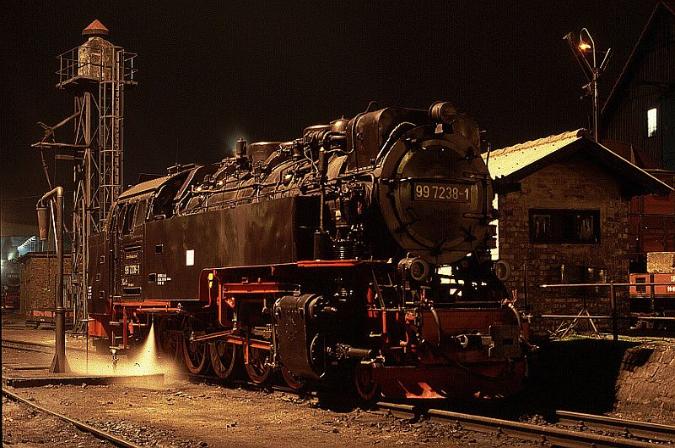
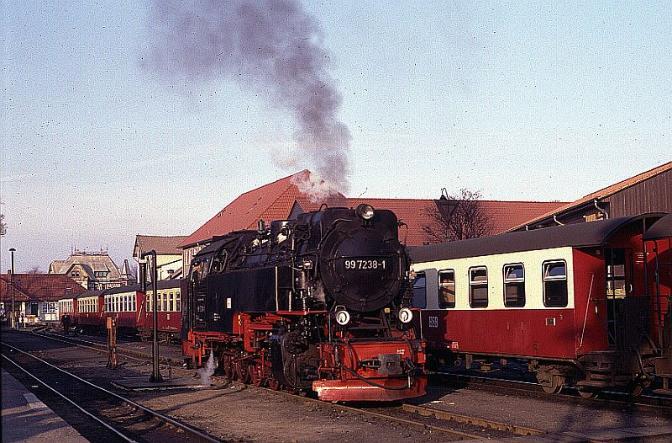
| Another of the LKM 2-10-0's No.99-7238 also stands in the yard in Wernigerode shortly after midnight on 4 April 1999. Night photography in pre-digital days was somewhat experimental and required a number of different exposures in order to achieve the optimum shot. |
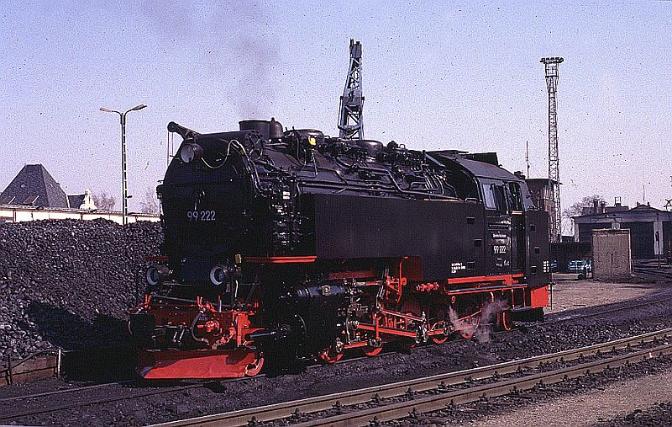
| Together with the LKM 2-10-2's is a single example built in 1954 by Schwartzkopff. Here it is seen in Wernigerode yard taking coal prior to the day's duties April 1999 |
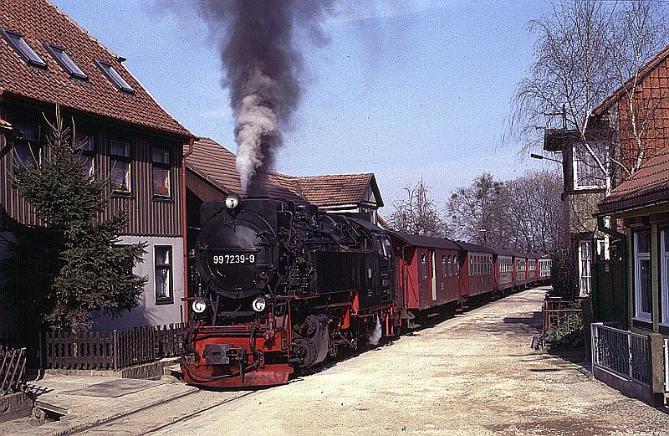
| Street running has always been one of my favourite scenes and so Kirchstrasse on the outskirts of Wernigerode was an obvious magnet. Imagine having this pass your front door a dozen times a day! In fact a car was parked right in the middle of this shot but a polite request to the local resident saw it moved around the corner to set up this fabulous opportunity. |
| Jung 0-4-4-0 No.99-5901 brings its service train out of Wernigerode and heads towards Drei Annen Hohne. This was one of three locomotives which was over 100 years old and going strong in 1999 having been built in 1897. One speculates how many diesel locomotives will achieve this kind of life span. |
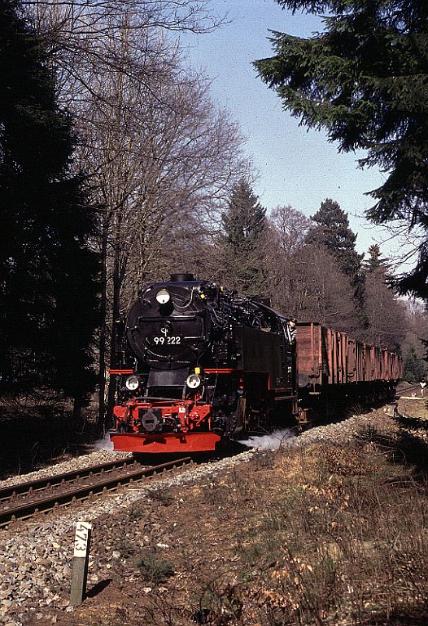
| By 1999 there were no regular freight operations on the Harz system but during the festival the opportunity was taken to recreate some of the scenes that were once commonplace on the lines. Standard gauge freight wagons from the Deutsche Reichsbahn were transported over the metre gauge system on transporter wagons and Schwartzkopff 2-10-2 No.99-222 brings such a train through the woods between Wernigerode and Drei Annen Hohne (right) |
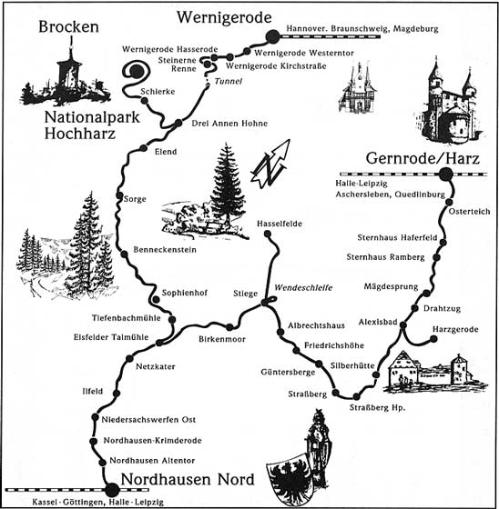
| Map (left) showing the lines and stations which together form the Harz system |
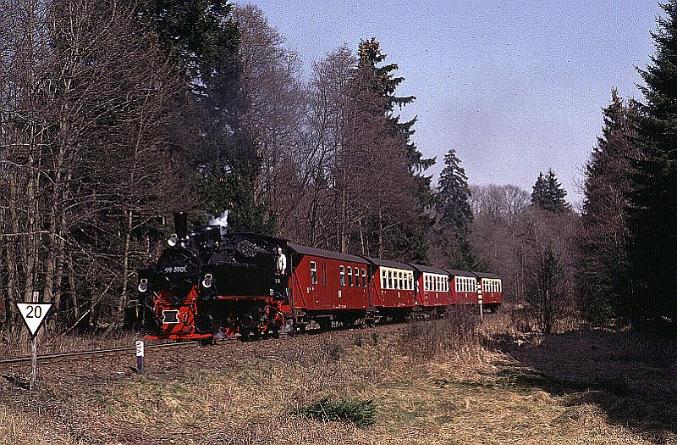
| Another shot of Jung 0-4-4-0 No.99-5901 as it brings its train of five bogie carriages through the woods on the approach to Drei Annen Hohne |
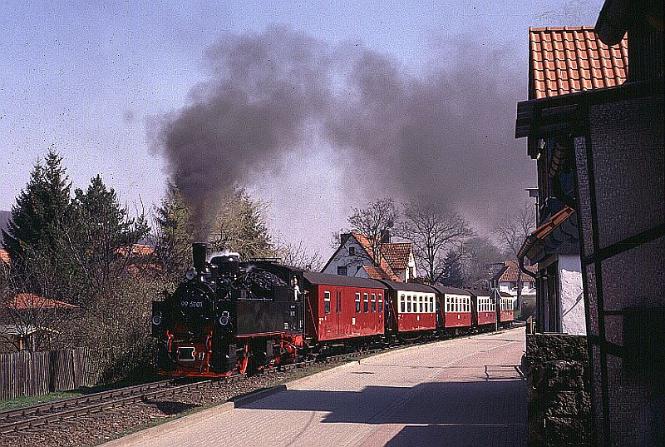
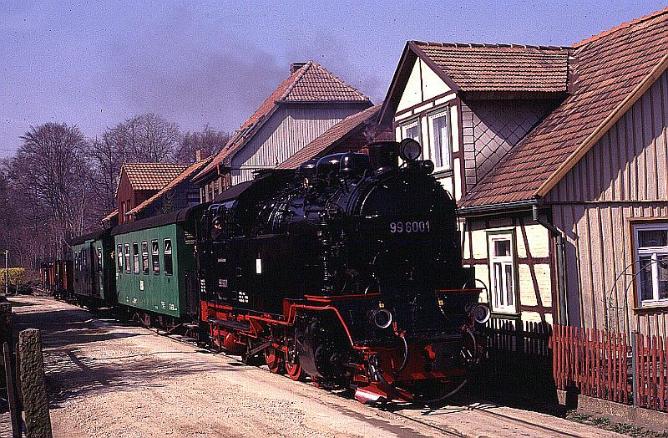
| Amongst the other locomotives owned and used on the Harz Railways is this Krupp-built 2-6-2T No.99-6001 seen passing through Kirchstrasse with a demonstration mixed train as part of the festival. Sadly such trains are no longer part of the scene on what is now a passenger only steam service. |
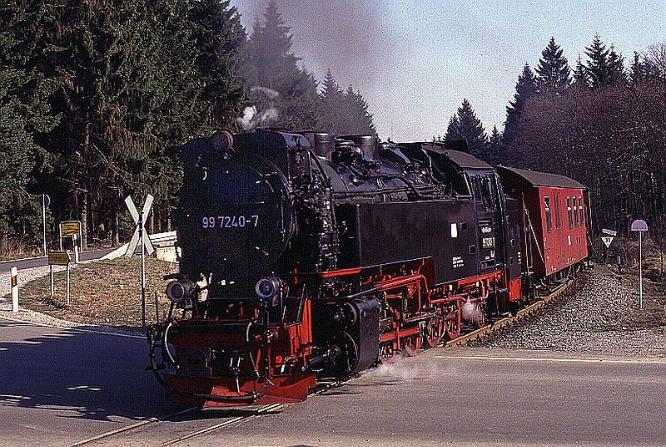
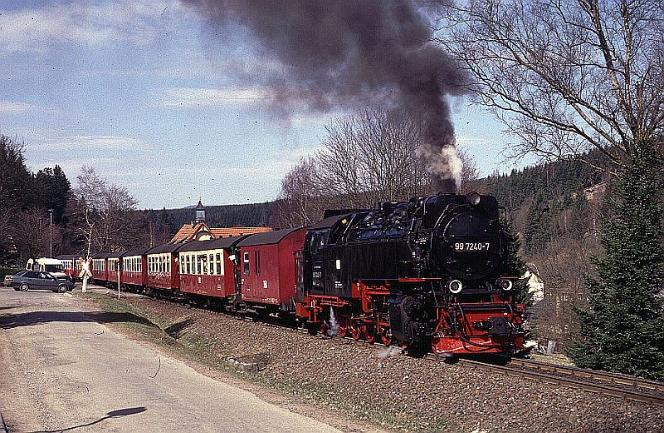
| The size and scale of the LKM 2-10-2's can be clearly appreciated as No.99-7240 brings a morning train across the road on the outskirts of Drei Annen Hohne. This was a favourite spot for watching trains with a rather delightful bratwurst stall doing a brisk business just behind where I was standing! |
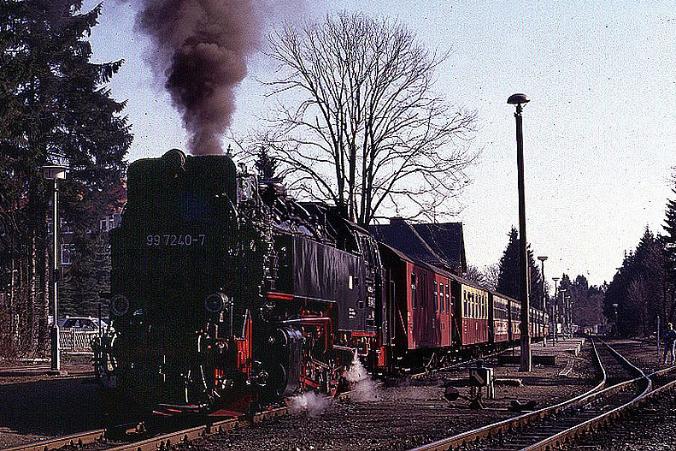
| No.99-7240 stands in Drei Annen Hohne station awaiting the arrival of the train returning from the summit of the Brocken. Drei Annen Hohne is 15km from Wernigerode and 19km from the summit of the Brocken. It not only serves as the passing point for trains working on the Brockenbahn but is also the junction with the Harzquerbahn which runs from here to the city of Nordhausen some 45km away. |
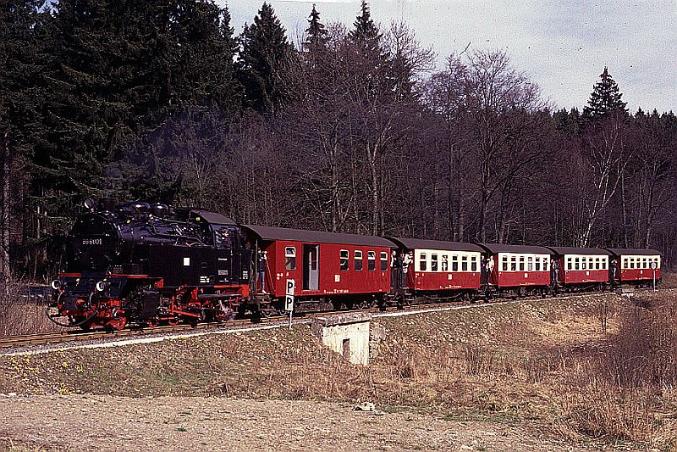
| Krupp 2-6-2 No.99-6001 begins the 19km climb from Drei Annen Hohne to the summit of the Brocken. During the Cold War the Brocken was a Soviet listening post and so from 1961 onwards the line beyond Schierke was closed and public access denied until 1989. The line itself did not open until 1991 but now visitors are once again able to ascend to the summit (1125 metres above sea level) and enjoy the spectacular views |
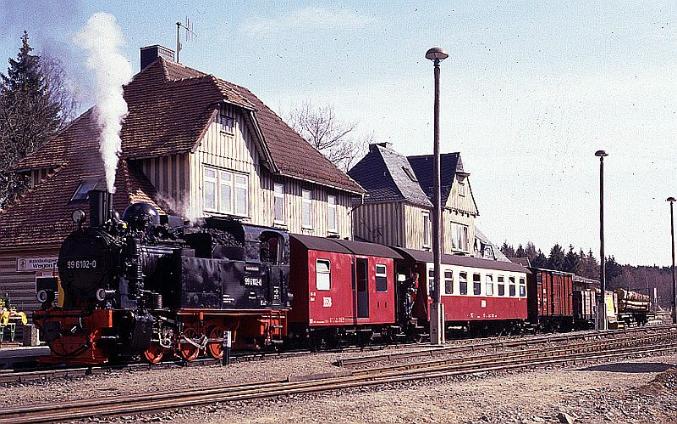
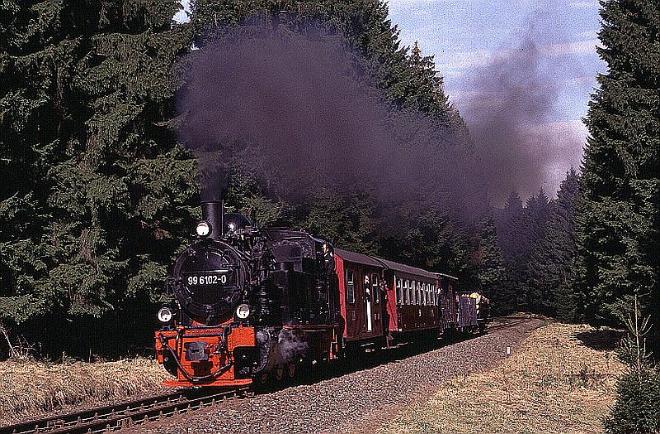
| Another one of the festival trains is pictured here at Elend station which is the first station out of Drei Annen Hohne on the line to Nordhausen. The locomotive is Henschel 0-6-0T No.99-6102 which is far too small to haul the normal service trains. |
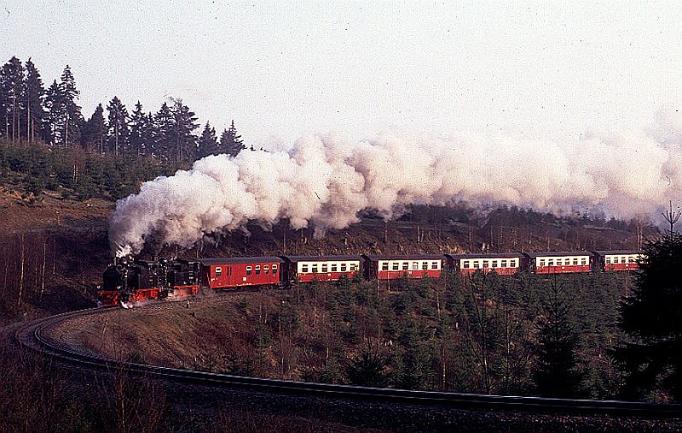
| Jung 0-4-4-0 No.99-5901 double heads a train from Wernigerode to Nordhausen together with MBG 0-4-4-0 No.99-5906. Normally the Mallets are used on the Selketelbahn where loadings are lighter and gradients less demanding. The location is between Elend and Sorge |
| Also seen between Elend and Sorge is Henschel 0-6-0T No.6102 on a demonstration mixed train |
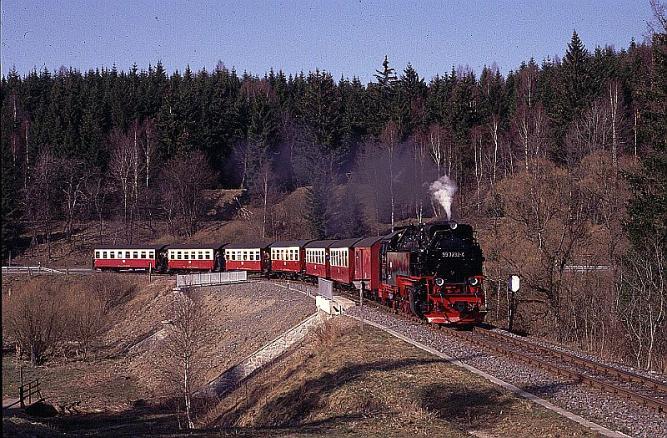
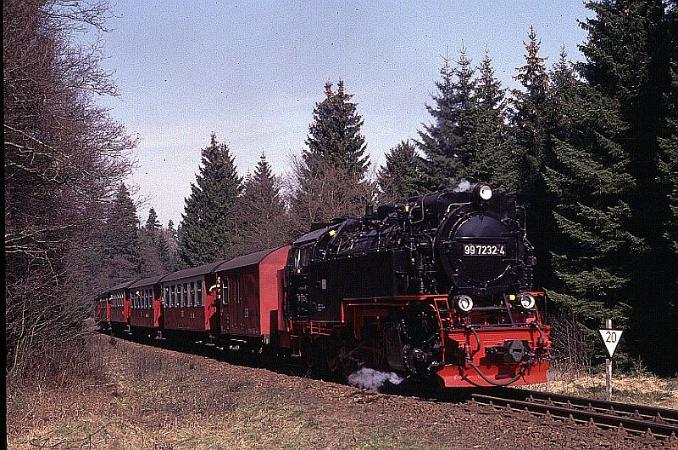
| In photographic terms I'm not sure it comes much better than this! LKM 2-10-2 No.99-7232 crosses the river on the approach to Sorge station with a service train from Wernigerode to Nordhausen. My high opinion of this picture was clearly shared by the owners of a guest house in the region who saw fit to use it on their web-site - a clear violation of copyright as no request had been made to me for its usage. |
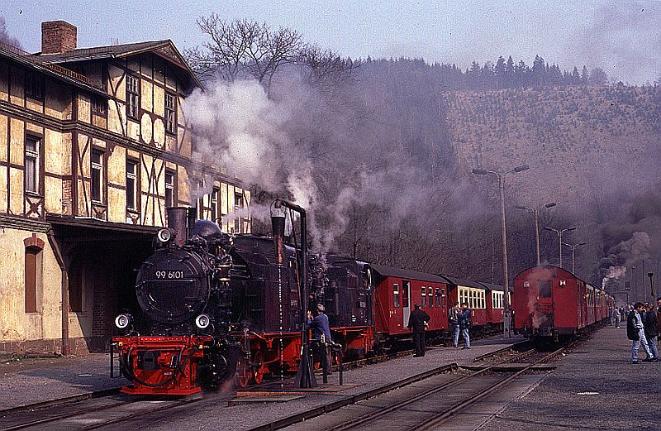
| Eisfelder Talmuhle is the junction between the Harquerbahn from Wernigerode and the Selketalbahn line from Gernrode. In 1999 it appeared to be almost completely unchanged from the former Deutsche Reichsbahn days with the half-timbered station in a state of semi-dereliction. On the left Jung 0-4-4-0's No.99-6101 and No.99-5902 are taking water prior to heading to Nordhausen with a special train while LKM No.99-7238 stands at the head of a train bound for Drei Annen Hohne and onwards to Wernigerode |
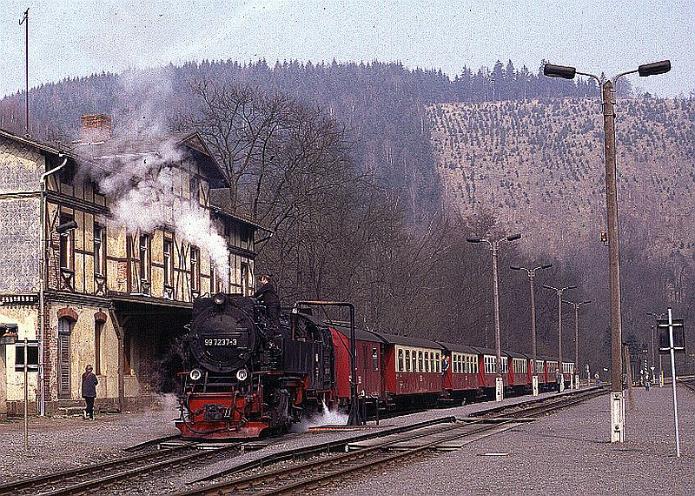
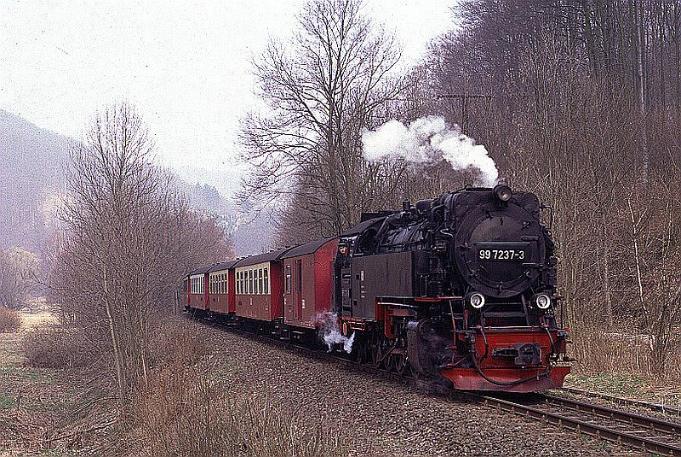
| LKM 2-10-2T No.7237 at the head of a service train, on a slightly gloomy afternoon, running between Eisenfelder Talmuhle and Ilfeld |
| LKM No.99-7232 at the head of an afternoon service train from Wernigerode to Nordhausen runs through wooded scenery as it approaches Ilfeld station |
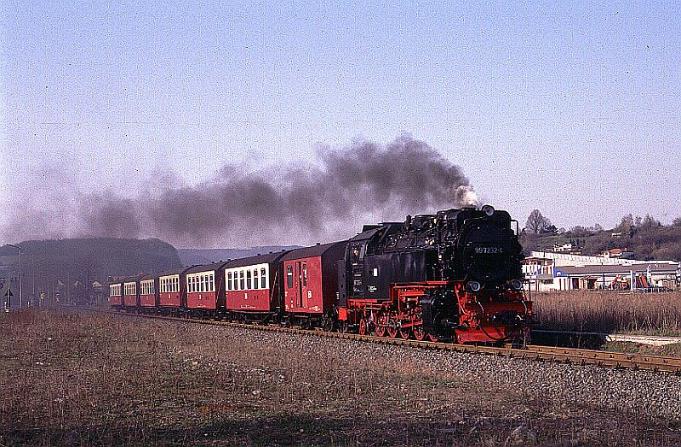
| The same train is seen running through the somewhat flat landscape as it approaches Nordhausen at the end of its 60km journey from Wernigerode. The line here features a stark contrast between the traditional steam locomotives and modern state-of-the-art diesel railcars which operate the local suburban service. |
| More typically LKM No.99-7238 takes water at Eisfelder Talmuhle having brought a regular service train from Wernigerode. The is currently no steam service between here and Sorge meaning that sadly the whole system can no longer be ridden behind steam |
| Sorge station is at the foot of a fairly steep climb and LKM No.99-7240 is working hard to get its train on the move after a brief stop for passengers. |
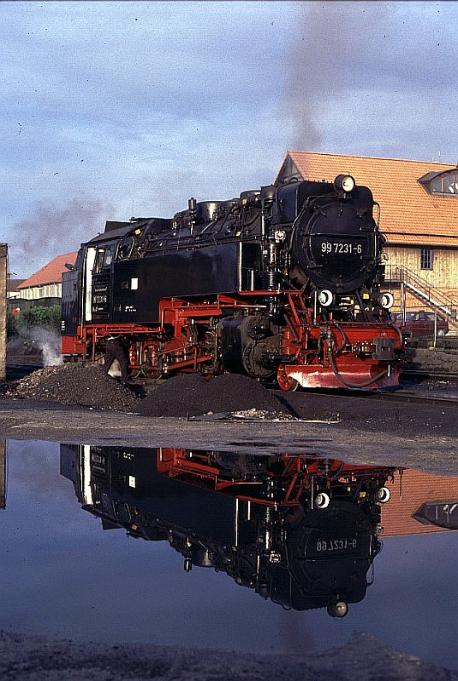
| The weather in April can be somewhat unpredictable and Steve Naconeczny and I were delighted to spend the first two days of our visit to the Harz enjoying glorious spring sunshine. However the picture on the Sunday morning was not quite as rosy! Skies were leaden and rain was falling in copious amounts. Since photography was more or less out of the question we decided to ride the service train from Wernigerode to Nordhausen and back - a pleasant and inexpensive way to spend a day. The coaches have open balconies and we were able to ride some 120km immediately behind the engine and enjoy the sound of the 2-10-2 as it battled the gradients. It was still raining on our late afternoon return to Wernigerode and so we returned to the hotel for a shower and a change into dry clothing. Glancing out of the window I was amazed to see a large patch of blue sky heading towards Wernigerode. Steve was dragged from the shower and we made a quick return to the shed area. The yard was full of huge puddles and provided a fantastic opportunity to take a shot of LKM No.99-7231 and its mirror-like reflection. This 'window of opportunity' was fairly short lived but we sought to make the most of what was on the yard prior to the hole in the sky closing over and the start of further overnight rainfall. |
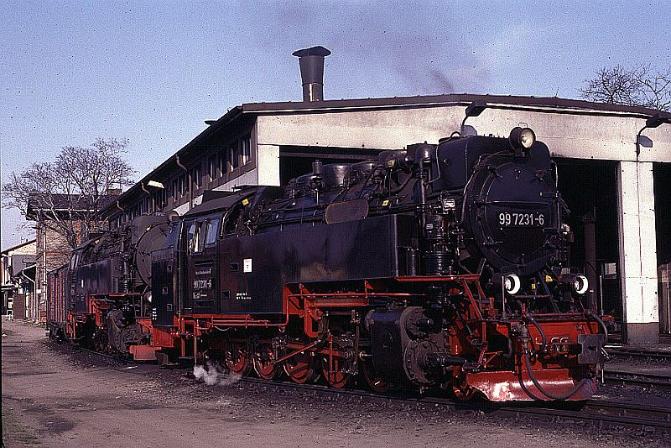
| The contrast between the dark skies and the late afternoon sunshine can be clearly seen in this second shot of No.99-7231 |
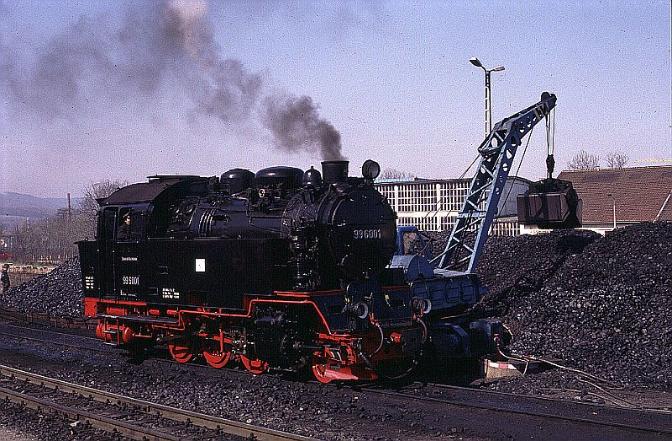
| A return to bright skies and sunshine the following morning as Krupp 2-6-2T No.99-6001 takes coal in the yard at Wernigerode |
| LKM No.99-7231 and No.99-7238 in the yard at Wernigerode |
| The silence is broken by the sound of a pair of Henschels as No.99-6101 and No.99-6102 bring their special train up the hill and round the curve towards Drei Annen Hohne |
| Making light work of things, LKM No.99-7234 brings an afternoon train through the woods between Steinerne Renne and Drei Annen Hohne |
| Late afternoon in Wernigerode station and LKM No.99-7238 runs round its train having just returned bunker first from Nordhausen. The carmine and cream coaches provide a perfect compliment to the black and red of these magnificent engines. |
| HARZ MOUNTAIN RAILWAYS HARZQUERBAHN, SELKETALBAHN & BROCKENBAHN |



| ||||||||||||||||